
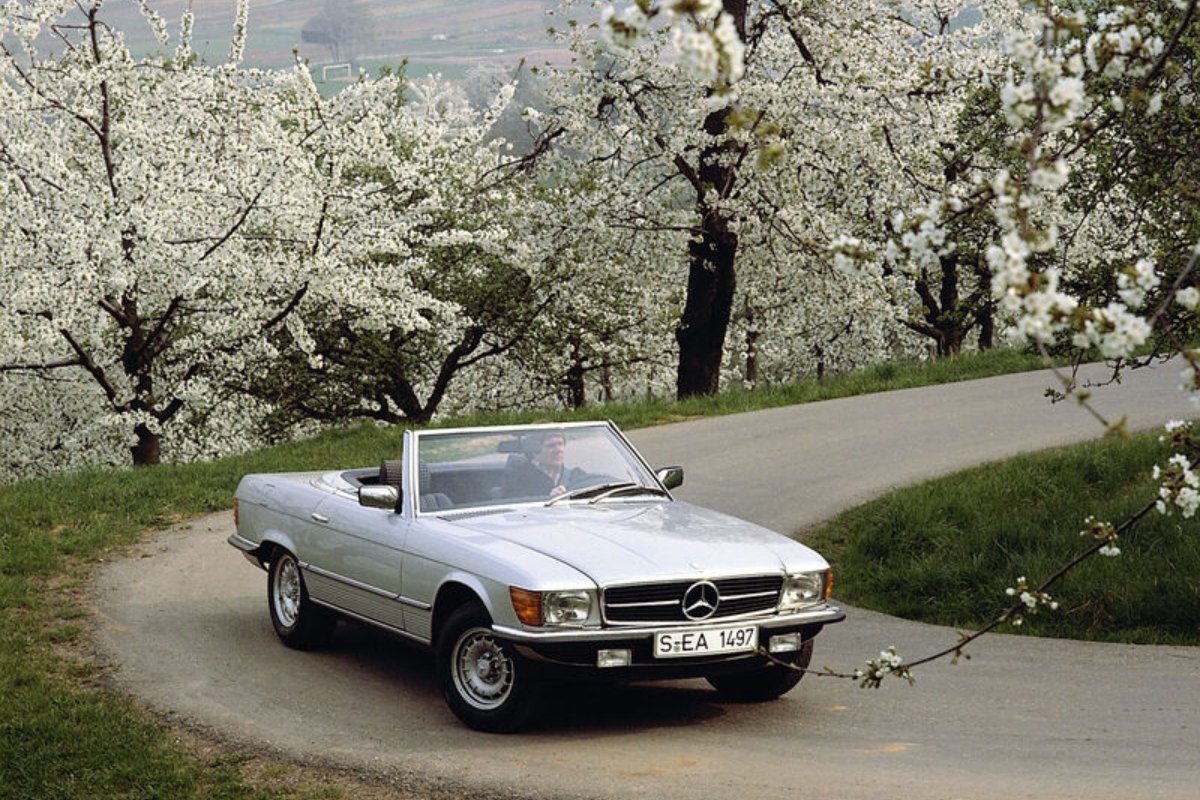
The Mercedes R107 SL, built from 1971 to 1989, is the rare classic that is plentiful, easy to live with and still sensibly priced, while the very best examples have started bringing serious money. Below: the history, the market, the version to buy and exactly what to check before you do.
Eighteen years, one roadster
Mercedes-Benz unveiled the R107 in April 1971 as the 350 SL, and the Sindelfingen plant kept building it until August 1989, for a total of 237,287 roadsters. Hagerty calls it the longest-running SL series of all.
America was the point. Daimler’s own history notes the 450 SL was reserved for North American export from autumn 1971, two years before European buyers could order one. The earliest US cars actually wore 350 SL badges over a 4.5-liter V8; the US lineup then ran 450SL (1973 to 1980), 380SL (1981 to 1985) and 560SL (1986 to 1989).
There was also a coupe. The C107 SLC, launched the same year on a longer wheelbase with four seats, was sold in the US as the 450SLC through 1980 and the 380SLC in 1981, then dropped. Production records compiled by the enthusiast registry mb107.com put SLC output at 62,888 cars.

A design built for safety and for the long haul
The final shape was overseen by Friedrich Geiger, the company’s longtime design chief, working with stylist Joseph Gallitzendörfer. During development it picked up the nickname “Panzerwagen,” according to Hagerty UK, and the engineering explains it.
Daimler lists a fuel tank moved above the rear axle for rear-impact protection, high-strength steel in the A-pillars and windshield frame, bonded-in glass and a padded four-spoke safety wheel. ABS became available in March 1980 and a driver’s airbag in January 1982.
It was always a two-seater with a folding soft top and a removable hardtop, and the 1980 update brought a cabin in the style of the W126 S-Class. That combination, an open car with a coupe’s roof for winter, is a large part of its appeal in New England.
Why it’s the classic car of the moment
Not because it’s a speculative rocket. The R107 isn’t on Hagerty’s 2026 Bull Market list, which went instead to cars such as the Porsche Carrera GT, the 1969 to 1972 Alfa Romeo GTV and the Continental Mark II. Its case is access: a famous name, huge supply and prices that, outside the very best cars, remain within reach.
The numbers tell the story. In a 2019 market analysis, Hagerty reported that average #2 (Excellent) values for the 560SL fell in every price-guide update from January 2017 to September 2018, a drop of 12.58 percent over two years. Hagerty’s online valuation tool lists a 1989 560SL in #3 (Good) condition at about $24,900.
At the top, it’s another market entirely. In August 2024, a 1989 560SL with 122 miles sold for $260,400 at Broad Arrow’s Monterey auction. Hagerty noted that was ten times the median 560SL sale of about $26,000, and that the next-lowest-mileage car among 245 recorded sales had 1,900 miles. Originality and mileage, more than model year, decide what an R107 is worth.
Then there’s the screen time. In Paul Schrader’s American Gigolo (1980), Richard Gere’s character drives a black 450 SL with US-spec bumpers and whitewall tires. On Dallas, Bobby Ewing’s regular cars were red R107s, a 450 SL, a 380 SL and a 560 SL, often wearing the plate “EWING 4.” Few cars say late-century American money as fluently.
Easier to live with than most classics
Most R107s were ordered with the four-speed automatic, and the hardtop, standard on all SLs from early 1980 according to Hagerty UK, shuts out far more wind and road noise than the soft top. Later US cars add ABS and an airbag. This is a classic you can take on a fall foliage drive through New England without a chase car.
Hagerty’s Rob Sass made the point back in 2011, observing that old Benzes were still a common sight on Los Angeles roads long after other cars of the era had thinned out. It still suits the city: an R107 belongs on any list of cars for 36 hours in Los Angeles.
For more on buying older cars, see my stories I paid $30k to enjoy every E39 BMW and I Bought 10 Mazda Miatas; for the opposite end of the spectrum, there is my Aston Martin DBX 707 driving review.

Which Mercedes R107 SL to buy
The 560SL: the last and strongest US car
Sold here for the 1986 to 1989 model years, the 560SL carried a 5.6-liter V8 rated at 227 hp and 287 lb-ft, with a top speed of about 140 mph. Hagerty lists a revised rear suspension, limited-slip differential, anti-lock brakes and an airbag, along with a launch price of $48,000. At 3,781 pounds it was also the heaviest SL of the era. Sindelfingen built 49,347 of them, and Hagerty’s Sass called it the first car in the series with real horsepower.
The 450SL and 380SL: the value play
MBCA’s The Star argues that on a modest budget, a well-kept 450SL or 380SL is a better buy than a 500SL or 560SL. The early, small-bumper 350 and 450 SLs are, in Hagerty’s view, the most desirable of all. From 1974, US cars carried bumpers lengthened by 8 inches at each end to meet the federal 5 mph rule; European cars kept the slimmer originals, which The Star considers the better-looking design.
Gray-market Euro cars and the SLC
Imported European 280 and 500 SLs, with their square European headlamps and sometimes manual gearboxes, can be appealing, but Hagerty calls them a mixed bag, so documentation matters. For coupe buyers, The Star calls the SLC the biggest bargain of the range.
Mercedes R107 SL buyer’s checklist
- Timing chain: 1981 to 1983 380SLs left the factory with a single-row chain prone to breaking. Confirm it was upgraded to the dual-row chain used from 1984, and that tensioners and guides were renewed within roughly 10 years or 100,000 miles.
- Fuel injection: Early cars used Bosch D-Jetronic, replaced by mechanical K-Jetronic from December 1975 and by KE-Jetronic in 1985. Injection faults are common on the V8s and costly to chase; use a specialist.
- Rust: Check above the headlamps, the lower front fenders, rockers around the jack points, floors, trunk, battery tray, around the windshield, the bulkhead and behind the bumpers.
- Hardtop and soft top: Make sure the hardtop comes with the car and inspect it. A damp cabin points to a worn top, tired seals or bulkhead corrosion.
- Vacuum systems: Test the central locking and climate controls, which run on vacuum and can leak.
- Steering and suspension: Look for steering-box play, worn bushings and a tired steering damper. Ask whether the front lower control-arm mount recall was performed.
- Leaks: Head gaskets on sixes and V8s; upper oil pan and rear main seal on the V8s.
- Originality and miles: Original, low-mileage, undamaged cars command the premium; restoring a poor car usually costs more than buying a good one.
- Inspection: Get a pre-purchase inspection from a Mercedes specialist. If the car will winter in the garage, add a battery maintainer to the budget.
FAQ
How many Mercedes R107 SLs were built?
Mercedes-Benz built 237,287 R107 roadsters at Sindelfingen between 1971 and August 1989. The related C107 SLC coupe added 62,888 cars, according to production tables compiled by mb107.com.
What is the best year for the R107 SL?
For power and safety equipment, the 1986 to 1989 560SL. For purity of design, an early small-bumper 450SL. Approach a 1981 to 1983 380SL only with proof its timing chain was upgraded.
How much is a Mercedes 560SL worth?
Hagerty’s valuation tool puts a 1989 560SL in #3 (Good) condition at about $24,900, and Hagerty put the median 560SL sale at roughly $26,000 in 2024. Exceptional low-mileage cars sit far above that, as the $260,400 Monterey sale showed.
Is the R107 SL a reliable classic?
It can be, provided the known weak points have been addressed: timing chain, fuel injection, vacuum systems and rust. A documented service history is worth more than shiny paint.
Tomorrow: why I ended up with two.
Leave a Reply